Rifle Scope Parallax Focus
from our good friends at US Optics
Whenever rifle scopes are discussed, a topic that frequently arises is parallax. There seems to be a great amount of misunderstanding and confusion concerning this subject. Parallax can be defined appropriately to rifle scopes as the apparent movement of objects within the field of view in relation to the reticle.
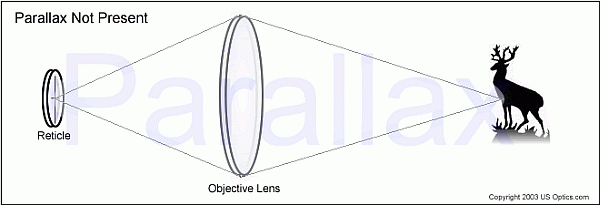
In a telescopic sight, parallax occurs when the “primary image” of the object is formed either in front of, or behind the reticle. If the eye is moved from the optical axis of the scope, this also creates parallax.
If the primary image is formed on the same focal plane as the reticle, or if the eye is positioned in the optical axis of the scope, then there is no parallax, regardless of the position of the primary image.
High magnification scopes, or scopes for long-range shooting, where even slight sighting errors would be serious, should be equipped with a parallax adjustment. This adjustment of the objective part of the optical system would ensure that the target can be brought in the exact focal plane of the reticle at any distance. Tactical style scopes are not usually supplied with parallax adjustment because the exact range of the target can never be anticipated. Scopes of lower magnification are not usually supplied with parallax adjustment either, because at lower powers the amount of parallax is so small as to have no importance for practical, fast target acquisition.
TWO FACTORS WHICH CAUSE AND DETERMINE THE AMOUNT OF PARALLAX IN A RIFLESCOPE:
1. The distance of the target to the objective–The objective lens forms a primary image of the subject being viewed and subsequent components invert the image, and there is no parallax. The actual position at which the image is formed is dependent on the distance the target is from the objective. Closer targets are formed farther away from the objective and farther targets are formed closer to the objective. Since the reticle is in a fixed position within the scope housing, the image is not always formed in the same plane as the reticle and, hence parallax.
2. The distance the eye can move from the optical axis of the scope, is determined by exit pupil size. There is no parallax, at any distance, as long as the eye is lined up exactly with the optical axis of the scope. An exit pupil small enough to do this would be impractical. It is important to know that in every scope, there is some parallax. It is also important to know that in every scope, there is some one shooting distance at which there is no parallax. In most rifle scopes this one point of zero parallax is usually placed at a suitable mid-range point in the scopes’ focal range.
In lower-quality scopes, there are other sources of parallax. If the reticle is not precisely placed the correct distance from the objective, the distance of no parallax will be exaggerated. Reticles that are not securely mounted and allowed to move even a few thousandths of an inch, will always have changing amounts of parallax. Parallax is also caused by optical deficiencies in the objective, either by design or manufacture. If spherical or astigmatic aberrations have not been corrected, images will form a considerable distance from the reticle. If you see a scope in which the apparent movement of the reticle compared with the image viewed is different from when you move your eye up and down than when you mover your eye side to side, it is because of a bad objective. No adjustment of the scope will eliminate these faults or optical deficiencies.
You can check the parallax of any scope by sighting an object at normal shooting distance (not indoors), by moving your eye side to side (then up and down), as far as you can, keeping the sighted object within the field of view. The apparent movement of the reticle in relation the target is parallax.